

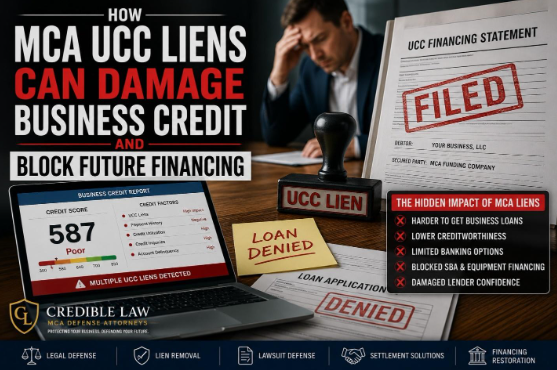
For many small businesses, obtaining financing is essential for maintaining operations, purchasing inventory, expanding marketing efforts, managing payroll, and handling unexpected expenses. However, business owners who rely on merchant cash advances (MCAs) often discover that the long-term impact of these agreements extends far beyond aggressive repayment schedules.
One of the most damaging consequences associated with MCA funding involves Uniform Commercial Code (UCC) liens and their effect on business credit, lending relationships, and future financing opportunities.
Across the country, businesses are increasingly reporting difficulties obtaining:
-
SBA loans,
-
equipment financing,
-
traditional lines of credit,
-
commercial mortgages,
-
vendor financing,
-
and refinancing approvals
after multiple MCA companies file UCC financing statements against the business.
As MCA stacking becomes more common, many business owners are learning too late that these liens can create major operational and financial obstacles.
What Is a UCC Lien?
A UCC lien is a public filing made under the Uniform Commercial Code that allows a creditor or financing company to assert a security interest in certain business assets.
In the MCA industry, funders frequently file UCC-1 financing statements shortly after funding is issued. These filings are often designed to:
-
secure repayment interests,
-
establish priority against competing creditors,
-
and notify future lenders that another financing company claims rights to certain business receivables or assets.
While many businesses sign agreements without fully understanding the implications of these filings, the impact can become severe once the company attempts to obtain additional financing.
Why UCC Liens Create Financing Problems
Traditional lenders generally evaluate risk carefully before extending capital to a business. When lenders review public records and discover active MCA-related UCC filings, several concerns immediately arise.
Lenders may worry about:
-
repayment priority conflicts,
-
excessive leverage,
-
strained cash flow,
-
ongoing litigation risk,
-
daily ACH obligations,
-
or competing claims against receivables.
As a result, businesses may experience:
-
financing denials,
-
reduced approval amounts,
-
higher interest rates,
-
or requests to satisfy MCA obligations before new financing can close.
In many cases, businesses only realize the seriousness of the issue after being declined by:
-
banks,
-
SBA lenders,
-
equipment finance companies,
-
inventory lenders,
-
or private credit providers.
This is one reason many companies seek guidance from experienced Merchant Cash Advance Defense Attorneys when attempting to stabilize operations and evaluate legal or restructuring options.
The Risks of MCA Stacking
MCA stacking occurs when a business takes on additional advances while prior positions remain active.
This often begins when:
-
cash flow tightens,
-
revenues decline,
-
inventory costs increase,
-
or daily ACH withdrawals become difficult to sustain.
Businesses may initially view additional advances as temporary relief, but stacking frequently accelerates financial pressure instead.
Each new position may increase:
-
daily withdrawal obligations,
-
lender conflicts,
-
UCC filings,
-
reconciliation disputes,
-
and collection exposure.
As repayment pressure intensifies, businesses can quickly reach a point where:
-
operating accounts become unstable,
-
overdrafts increase,
-
payroll becomes difficult,
-
or vendor relationships deteriorate.
At the same time, the existence of multiple UCC filings can severely impair the company’s ability to refinance into more stable capital solutions.
How MCA Agreements Affect Business Credit
Many business owners assume merchant cash advances do not affect credit because they are often marketed differently than traditional loans.
However, MCA activity can still negatively impact:
-
lender underwriting decisions,
-
commercial credit evaluations,
-
business banking relationships,
-
and financing eligibility.
In some situations, lenders reviewing a business may interpret stacked MCA activity as evidence of:
-
financial distress,
-
declining revenue,
-
poor cash flow management,
-
or heightened collection risk.
Even when the business remains operational and profitable, the appearance of multiple active funding positions can create underwriting concerns that substantially limit financing options.
UCC Liens and Operational Disruption
The problems caused by MCA-related UCC filings extend beyond financing denials.
Businesses may also encounter:
-
vendor concerns,
-
increased insurance scrutiny,
-
partnership hesitation,
-
acquisition complications,
-
or delayed closings during commercial transactions.
Potential investors or strategic partners frequently conduct due diligence before entering into business relationships. Active MCA liens and unresolved funding disputes can create uncertainty that discourages transactions.
For growing businesses attempting to scale operations, unresolved MCA obligations can become a significant barrier to expansion.
The Importance of Reviewing MCA Agreements Carefully
Not every MCA agreement is identical.
Some agreements are structured as:
-
receivables purchases,
-
revenue-based financing arrangements,
-
or commercial funding contracts.
Others contain language that more closely resembles traditional lending structures.
Businesses facing mounting pressure should carefully review:
-
reconciliation provisions,
-
default language,
-
remittance calculations,
-
ACH authorization terms,
-
UCC filing rights,
-
and enforcement clauses.
The legal characterization of an agreement may significantly affect:
-
available defenses,
-
litigation strategy,
-
enforcement rights,
-
and settlement leverage.
In many cases, businesses are unaware that they may still possess contractual or statutory rights worth evaluating.
Why Timing Matters
One of the biggest mistakes businesses make is waiting until:
-
accounts are frozen,
-
lawsuits are filed,
-
or financing collapses completely
before seeking legal guidance.
Early intervention can sometimes create opportunities to:
-
negotiate workouts,
-
address lien disputes,
-
reduce operational disruption,
-
evaluate settlement options,
-
or avoid escalation into litigation.
Once lawsuits, default judgments, or aggressive collections begin, leverage often decreases substantially.
Businesses facing these situations frequently research resources related to Merchant Cash Advance Lawsuits while attempting to understand the legal and financial risks associated with their funding positions.
The Role of Reconciliation Rights
Certain MCA agreements include reconciliation provisions intended to adjust payment amounts based on actual receivables performance.
However, disputes often arise regarding:
-
whether reconciliation rights were properly honored,
-
whether requests were processed fairly,
-
or whether collection practices remained consistent with the agreement terms.
Businesses experiencing significant revenue declines sometimes continue facing aggressive ACH withdrawals despite contractual reconciliation language.
This can accelerate operational distress and increase the likelihood of default disputes.
Reviewing reconciliation provisions carefully is often an important component of evaluating the overall enforceability and administration of an MCA agreement.
Financing Recovery After MCA Issues
Businesses impacted by MCA stacking and UCC filings are not always permanently blocked from obtaining financing.
However, recovery often requires:
-
stabilizing cash flow,
-
resolving active disputes,
-
addressing liens,
-
improving operational metrics,
-
and rebuilding lender confidence.
The process may involve:
-
negotiated settlements,
-
refinancing strategies,
-
restructuring efforts,
-
or litigation defense depending on the circumstances.
Because every funding structure differs, businesses should avoid assuming that all situations are identical.
Final Thoughts
Merchant cash advances can create immediate liquidity for businesses facing operational pressure, but the long-term effects of stacked positions and UCC liens can become extremely damaging if not managed carefully.
Business owners across the country are increasingly encountering:
-
financing denials,
-
aggressive collections,
-
litigation exposure,
-
and business credit complications
linked to MCA obligations and public lien filings.
Understanding the legal and financial implications early may help businesses preserve operational flexibility and avoid deeper financial disruption later.
For companies facing MCA-related pressure, obtaining experienced legal guidance and reviewing funding agreements thoroughly can be an important step toward protecting the business and evaluating available options moving forward.